
Implants vs Fat Transfer: What’s Better for Breast Enhancement?

When you are considering breast enhancements, you have two leading options:
Breast Implants
Autologous Fat Transfer (Fat Grafting) - Transferring fat from one body part to another, in this case, breasts.
Both procedures improve volume and shape. But, they differ in how much control you have over results, durability, risks, and who they suit best. And of course, techniques and material used.
Implants can be customised fully.
You can choose the feel, shape, size, cleavage projection and even slope. But that’s not possible with fat grafting. In fact, you lose 20-40% of fat that you transferred originally over the next 3-4 months.
Fat grafting is popularly chosen by people who only want subtle enhancement and want to remove a little fat from another region of the body. But for aesthetic reasons, most people prefer breast implantation over fat grafting.
This guide will help you make a medically informed decision.
Pros and Cons at a Single Glance -
Breast Implants | Fat Grafting (Fat Transfer) |
Pros: • Significant and predictable size increase in one surgery • Full control over shape, projection, and cleavage • Suitable for almost all body types, including slim patients • Long-lasting structural enhancement • Modern silicone implants offer very natural feel Cons: • Surgical procedure under anesthesia • Small incision scars • May require replacement after many years | Pros: • Uses your own fat (no implant device) • Natural look and feel • Includes body contouring from liposuction areas Cons: • Limited size increase (usually 0.5–1.5 cup sizes) • 20–40% fat may get reabsorbed • Results less predictable • Often requires multiple sessions for noticeable volume • Not suitable for very slim patients |
Understanding Breast Implants in Depth
How to choose the types of Breast Implants for yourself :-
Doctors choose the right breast implant based on your body type. They also check how much breast tissue you already have before deciding. Your desired size and lifestyle matters too. Most importantly, the implant should match your desired look and goals.
Silicone Gel vs Saline Implants
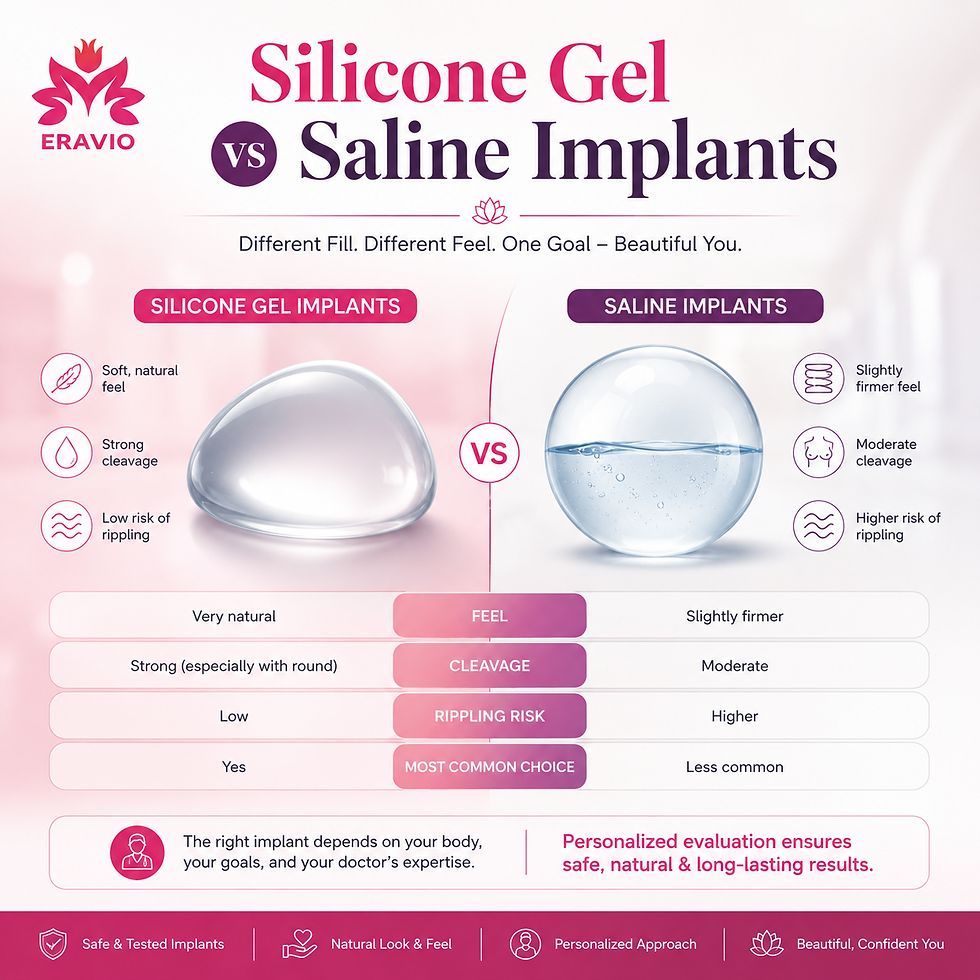
Silicone gel implants are usually preferred. They feel softer and more natural.
Saline implants are used in some selected cases. You can choose between round and anatomical (teardrop) implants.
Silicone | Saline | |
Feel | Very natural | Slightly firmer |
Cleavage | Strong (with round) | Moderate |
Rippling Risk | Low | Higher |
Most Common Choice | Yes | Less common |
Round vs Teardrop
Round implants give a fuller upper part of the breast. They also create more defined cleavage.
Anatomical or teardrop implants give a more natural slope.

The final choice depends on your goal. Do you want a noticeable change? Or a more subtle, natural look?
Many factors affect the final decision. These include your chest width and skin elasticity. The amount of sagging and placement also matters.
Round | Teardrop | |
Upper Pole Fullness | High | Low–Moderate |
Cleavage | Strong | Subtle |
Most Common Choice | Yes | Select cases |
A detailed consultation is very important. A good doctor will take proper measurements and your expectations are discussed clearly. It ensures safe, balanced, and long-lasting results.
What Implants Can Achieve
✔ Increase 2–4+ cup sizes
✔ Improve breast symmetry
✔ Restore post-pregnancy or post-weight-loss volume
✔ Provide long-term structural shape
Should you place breast implants under the breast tissue? Or under the chest muscle? Or should you use a combined method?
Under the breast tissue (subglandular)
Subglandular placement creates more visible fullness. It also gives stronger cleavage. Doctors usually choose this option for women who have enough natural breast tissue.
Under the chest muscle (submuscular)
Submuscular placement gives better implant coverage. It creates a more natural upper slope. Doctors often prefer this option for thinner patients.
Dual-plane (combination)
The dual-plane technique combines the benefits of both methods. It gives a natural upper contour and provides good projection and shape. Because of this, doctors commonly recommend it for cosmetic breast augmentation.
The ideal choice is determined after assessing tissue thickness, skin elasticity, degree of sagging, and your desired outcome to ensure balanced, long-lasting, and natural-looking results.
Factor | Under the Breast Tissue | Under the Chest Muscle | Dual Plane |
Upper Fullness | High | Moderate | Balanced |
Natural Slope | Moderate | High | High |
Cleavage Definition | Strong | Moderate | Strong |
Implant Visibility Risk | Higher in thin patients | Lowest | Low |
Recovery Discomfort | Less | More | Moderate |
Long-Term Stability | Good | Very Good | Excellent |
Understanding Fat Transfer (Fat Grafting)

Fat transfer uses your own fat cells taken through liposuction from areas such as:
Abdomen
Thighs
Flanks
Lower back
The fat is purified and strategically injected into the breasts.
What Fat Transfer Can Achieve
✔ Increase 0.5–1.5 cup sizes that may reduce over time (subtle enhancement)
✔ Improve contour irregularities
✔ Correct mild asymmetry
Survival Rate
Only 60–80% of transferred fat survives. The rest gets reabsorbed by the body within 3–6 months.
Sometimes, a second session may be required to achieve desired volume.
Ironically, injecting too much can make less fat survive.
Think of It Like Planting Seeds
If you:
Plant seeds spaced out → They grow
Dump them in one tight pile → They suffocate
Fat grafting works the same way.
Possible risks:
Fat necrosis lumps
Oil cysts
Calcifications (may interfere with mammogram reading)
Uneven results
Higher revision rates
If someone wants a visible transformation, especially after:
Pregnancy
Weight loss
Naturally small breasts
Significant asymmetry
Fat grafting alone is often insufficient.
Implants Give You Exact Control
With implants:
✔ You choose the size✔ You choose projection✔ You choose profile✔ You choose cleavage level
With fat transfer:
❌ 20–40% of fat gets reabsorbed❌ Final size cannot be precisely predicted❌ Results vary from person to person
Implants do not depend on survival rate.
The volume you place is the volume you get.
If you want complete control over the outcomes, choose breast implants. But if you only want some subtle enhancements, choose fat grafting.
Factor | Breast Implants | Fat Transfer |
Volume Increase | High | Moderate |
Predictability | Very High | Moderately variable |
Feel | Soft (especially silicone) | Completely natural |
Longevity | 10–20+ years | Permanent (after stabilization) |
Scar Size | Small surgical incision | Small liposuction + injection scars |
Anesthesia | General | General or sedation |
Risk of Capsular Contracture | Present | None |
Requires Body Fat | No | Yes |
Future Maintenance | Possible implant replacement | Rarely required |
Safety & Risks
Implant-Specific Risks
Capsular contracture
Implant rupture (rare with modern implants)
Implant displacement
Need for revision surgery in future
Fat Transfer Risks
Fat necrosis (small lumps)
Uneven absorption
Need for repeat session
Both procedures are safe when performed by experienced surgeons in an accredited facility.
Who Is the Ideal Candidate?
Choose Implants If You:
✔ Want a noticeable natural-looking size increase
✔ Want predictable cup size
✔ Desire defined cleavage
Choose Fat Transfer If You:
✔ Want only subtle enhancement
✔ Prefer no foreign material in body
✔ Have stubborn fat areas
✔ Are okay with losing
Cost Consideration in India
Breast Implants: Higher upfront cost but predictable result
Fat Transfer: Cost includes liposuction + grafting, so high either way, may increase if second session needed
Implants may require replacement after 10–20 years, which should be considered long-term.
Can They Be Combined?
Yes.
Hybrid breast augmentation combines:
Smaller implant
Fat grafting for contour smoothing
This offers:
✔ Enhanced cleavage ✔ Natural edges ✔ Balanced projection
Final Verdict: What’s Better?
There is no universally “better” option.
If you want noticeable transformation → Implants are superior.
If you want only subtle enhancement → Fat transfer is ideal.
If you want the best of both worlds → Hybrid technique may be recommended.
The best procedure is the one tailored to your body and goals.
Expert Consultation Matters
Every breast is different. A proper assessment includes:
Skin elasticity evaluation
Chest wall measurements
Existing breast tissue volume
Body fat percentage
Lifestyle and fitness habits
At Eravio Clinics, treatment plans are personalized after detailed consultation and medical evaluation.


Comments